Friday, July 28, 2017

President Farmajo’s Delicate Balancing Act

President Farmajo’s Delicate Balancing Act


By Heikal I. Kenneded
Monday, July 24, 2017
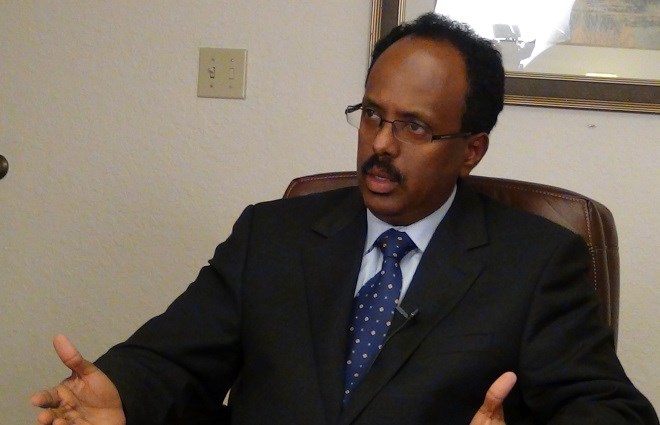


President Farmajo came to office scarcely five months ago.  His election was a transformational moment for Somalia has rarely appeared more united than when he was elected as a president.  He campaigned to eradicate corruption from the ranks of government and more importantly to either bring the Al-Shabab terrorists into the fold or wipe them out. Yet he had many more challenges awaiting him, inheriting a country in disarray, politically deadlocked and financially strained, not to mention a dismal state of insecurity.  The biggest single problem for the president, however, has been the fight against corruption as a broader strategy against terrorism.  Nonetheless, his recent declaration of waging war against the Al-Shabab terrorists while dressed in military fatigues and the subsequent flawed disarmament of the capital’s remnant warlords from illegal arms were a bit misplaced and rather naïve.  The real culprit sustaining the intransigent Al-Shabab terrorists in the country is the shadowy and unregulated finance methods based on mobile money-transfer system that they use to finance their deadly attacks.  Unless the government goes after the illegal resources funding these terrorists, their efforts will be futile.  The fight against corruption as a first-order national security priority must be able to follow the trail of the money.  The government has to find a way to completely take control of the flow of money inside the country and that will mean reining in the elusive mobile money-transfer system, while revitalizing the traditional formal banking system. Categorically, mobile payment system has become the bank of choice for the terrorists, which is firmly controlled by rogue businessmen who neither care about country nor freedom, but President Farmajo’s government should strive to reverse this risky finance system.

 If President Farmajo wishes to be more pragmatic than his predecessors in prioritizing the security and financial transparency of the country, then he needs to be very careful not to get caught up in a trap of his predecessors’ making by succumbing to the country’s Big Business entrapments.  Though, a government like Somalia with a fledgling economy is bound to find itself at the mercy of local Big Businesses for loans and financial support.  But alos at the same time to come hard against their butter and bread that’s a delicate balancing act.  In fact, how President Farmajo handles that very balancing act may determine the future success or failure of his government.  In other words, fighting terrorism and corruption without alienating Big Businesses is a very tricky balance.  Most experts on terrorism agree that long gone are the days of trying to defeat terrorists by waging a war, but disrupting their supply of finance should be the most critical target. On the other hand, those arguing how the services provided by the telecom industry and Big Businesses’ economic contribution to the development of the country in general to outweigh the security of the country are merely hardened capitalists who care nothing about peace and the safety of generations to come.


The President still has time to learn from the mistakes by his predecessors; unless he’s too squeamish to stand up to these rogue capitalists and see them in their true color – war profiteers.  For the moment, the President is moving cautiously in the direction of financial reform as his administration reprints the country’s first Somali Shilling notes in more than a quarter century, while trying to collect local taxes.  The most astonishing aspect of Al-Shabab’s resilience for the last decade is despite under severe pressure, they still manage to wreak havoc on Somali societies most vulnerable.  More fundamentally, these terrorist are increasingly financing themselves and disrupting their supply of finance is a critical issue.  Hence, the efforts to clamper money-laundering and counter-terrorism through the digital system should go hand in hand and the government will be able to kill two birds with one stone. Of course, the country’s very powerful telecom companies will surely retaliate and resist such necessary regulatory changes that will most likely strangulate their businesses.  What form could such regulations take?  First, instead of asking telecom and wire-transfer companies to self-regulate, ask them to get in sync with the country’s telecommunication and banking regulatory framework and become accountable to the country’s laws. Because if these companies are allowed to continue in their current lazes faire trend, they are bound to run the country to the ground.

It’s no coincidence that mobile money-transfer systems are most prevalent in countries with feeble financial laws and failed states like Somalia with either little or no enforcement against financial fraud and money-laundering schemes.  The sole reason that customers regularly need not to prove their true identity is what draws terrorists to launder their illicit finances through the mobile money-transfer system.  The fact is that, the entire mobile money transfer process often circumvents a country’s financial reporting system, which makes it almost impossible for government authorities to take a stock of these subtle digital transactions.  The government has every right to track and trace all digital financial transactions in relation to terrorism and money-laundering.  This will require, however, the Somali government to first seek assistance with the formidable technological know-how necessary to detecting and monitoring these elusive transactions.

The Dilemma

Since the collapse of the Somali nation-state, coupled with the disappearance of the federal financial banking system, money laundering and terrorism have thrived with the advance of using mobile money transfer system.  It’s a high time that the new Somali government administration shift its gears to monitoring the flow of digital funds that finances terrorism. Since these transactions are made through mobile phones and text messages, there’s naturally no way to trace them, let alone secure proof for prosecutions.  The current federal government should incorporate a concrete financial instrument of national power in their efforts to combat terrorism and corruption.  Unscrupulous money laundering throughout the country and mafia style of levying businesses illicit taxation that foster terrorism finance measures have significantly hamstrung the current struggle to uproot terrorism in Somalia. 

During the past decade, Al-Shabab operatives have mainly financed their terrorist operations and supported their networks by borrowing a page from the Mafia-style shakedowns of local businesses that pay monthly “zakat” donations for protection.  In fact, it’s no secret that most of Mogadishu’s major businesses that recent years became major targets for terrorist attacks were the ones who either delayed or declined their monthly extortions levied by the Al-Shabab for whom threats, intimidation, extortion and violence have become a modus operandi. Similarly, reigning on the hawala wire transfer system, as most developed countries have carried out recently is worth duplicating.  In other words, following the money trail and surveillance of facilitators, like the telecom industry and hawala wire transfer companies in their involvement efforts to move and shelter money for terrorist and criminal groups, it will produce critical financial intelligence that will lead to the weakening of illicit actors such as Al Shabab and other corruption agents.

Although mobile money transfers system has provided Somalis with a lifeline to remittances from around the globe, not to mention with unprecedented access to goods, services, capital and information – better, faster, and cheaper. In fact, greater efficiency in wiring money has sustained the country’s fragile economy during the past quarter century.  Millions of Somalis now use their mobile phones to manage their finances and their numbers are growing daily. Despite all the great benefits resulting from a better access to capital, the dark side of mobile money transfer concurrently has sanctioned and empowered terrorism, crime, and corruption around the country.  In other words, while mobile money transfer promotes greater access to capital and livelihood, on the same vein it sponsors illicit activities that render impossible for traditional investigative tools like “following the money trail” for the government to better understand, detect, disrupt and dismantle these illicit networks that eventually sponsor terrorism.  Thus, closely auditing the digital financial flows around the country should be paramount in fighting against the intransigent Al-Shabab terrorism.

Dozens of street-corner shops in Mogadishu sell hundreds of thousands of mobile-phone airtime and thus having a strong command of the county’s hard currency, and yet not accountable to any government regulations.  It’s no secret that these telecom companies have made unholy alliances with the Al-Shabab terrorists for protection.  Since annually an estimated $1.4 billion of Somalia’s GDP out of $6 billion of imports comes from in the form of remittances from Somalis living in the diaspora, there’s a huge risk of falling into the hands of terrorists. Since customers trade cash for virtual charge that goes into their phone, which becomes an electronic account.  These customers can then pay bills, buy essentials, transfer funds and more importantly receive credit on their phones.  Besides being easy to use, it’s usually virtually way less transparent than traditional money-transfer services.  Thus, it’s no wonder that the Al-Shabab terrorists found a safe-haven in these impersonalized financial transactions to run their extortion businesses that finances their deadly attacks.  In lieu of this risk, the current Somali government has to do broad consultations with both the private and public sectors in order to assure investors on what this will mean for trade and business.

The ultimate question is whether anything can be done to curb the telecom companies that collude and facilitate terrorist activities.  The answer is surely yes.  The previous governments have obviously underestimated the potential threat presented by these unregulated telecom companies and their dangerous involvement with the terrorists than many have realized, and it is high time to confront them with the urgency, intensity, and resources they deserve.  In doing so, President Farmajo can help rebuild a Somali society that is not only more transparent and accountable, but also more secure and safe from the existential threat of terrorism.

Finally, President Farmajo’s government faces a stark choice to either appease the country’s strong Big Business, including telecom companies like Hormud and Dahabshil, or to honestly curb the horrible atrocities daily visited on Mogadishu’s residents by Al-Shabab, by any means necessary.  These resilient terrorists have proven time and time again they cannot be easily dislodged from their hideouts by the muzzle of the gun or intense drone attacks to root them out.  A paradigm shift is needed from the current Somali government to fight terrorism and there’s no better place to start with reigning in the country’s incorrigible telecom companies. Telecom companies to be in compliance they need to closely work with the federal telecommunication ministry, the National Bank and other financial regulators to review the systems and regulations in place to ensure they meet the highest national financial standards. The same strict regulatory standards should be imposed on remittance wiring companies like the hawala for international funds transfers in order to control any potential illicit wiring to terrorists. 

Heikal I. Kenneded
Washington D.C.

Thursday, February 2, 2017

Somalia: No Country for Honest Men
“Every nation gets the government it deserves”

Thursday, January 26, 2017
By Heikal I. Kenneded


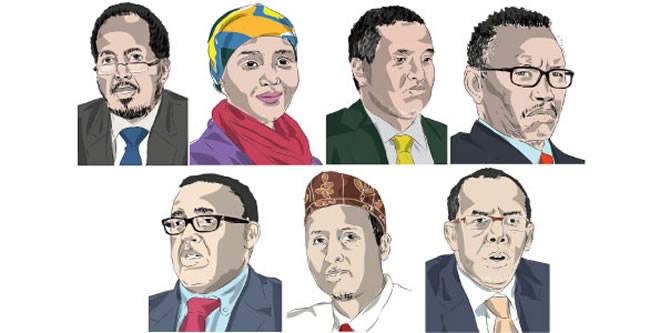
                                             Somalia presidential candidates. 


In more than three trips to Somalia over the past five years, I’ve come to rewrite my own perception of where the country is headed and it doesn’t look promising because the future of Somalia looks gloomier than at any time in post-civil war era. Despite the positive tone of my past comments of the country and much of what I often write about Somalia, especially my belief that Somalia is on the mend to recover from its horrific collapse. Regrettably on my most recent trip, I did find myself tormenting more and more about the dismal record of current cadre of leadership who are in power, not to mention those others who are vying to run the country. Just when things seem as though they can’t get any worse in Somalia, the country finds itself much worse predicament that puts everyone else on the edge. The picture is not only disturbing but rather disheartening because the country’s economy remains fragile at best, as recovery continues to be hampered by the challenging security environment posed by Al-Shabab and widespread corruption that pervades every sector of the country from the highest government officials to local security forces to non-government institutions (NGOs), not to mention avaricious money-lords who privatized most of the basic services, including telecommunication, healthcare, schools, power plants, banking and even created their own private security forces. As a result, I came to the kernel truth of how Somalia has become a den for corrupt politicians backed by merciless businessmen who would not hesitate to run the country to the ground in order to enrich themselves and there’s no place for honest men or women. Corruption is the single biggest threat to Somalia’s path towards a lasting peace and prosperity.


I flew into Mogadishu in the week leading to the elections for the Speaker of the parliament and his deputies and I saw it with my own eyes the vicious political wheeling and dealing among the country’s political elites who eventually elected two out of the three officials from the last parliament to their old seats. Ironically, in a country where no significant wages were paid in the last seven months to both the security forces and the civil service employees, including the MPs, a great deal of money is floating around in the capital. On daily basis, expensive parties are thrown throughout Mogadishu's hotels, where presidential candidates backed by foreign elements are readily spending a huge amount of cash in order to court MPs' vote in their favor. If it's any indication of the recent parliamentarian elections that has revealed how financial factor is the sole driver of winning their seats by a great majority of members of the parliament (MPs), there's a little chance that they will abide the constitution and elect the best candidate for the job. This will have the catastrophic consequence of throwing back the country in the back burner and risking both the territorial and maritime of Somalia to get annexed by neighboring countries, who have been eyeing for a long time Somalia’s exceptional strategic location and abundant natural resources.

A City of Two Tales 
Mogadishu is fast becoming a city defined by its disparate lives – those few high profile corrupt politicians and money-lords who live the lavish lives, as millions of the populace struggle to get by as they are deprived of basic necessities, such food, clean water, sanitation, housing and access to healthcare and proper education.  In effect, corruption in the country has created unprecedented extreme poverty and exclusion. Shortly after I arrived at the capital, I decided to take a tour around the city and it would be an understatement to say the least that I was shocked to witness the extensive level of gun culture of various forces in full army gear riding in the back of their pickup trucks. I drove by the military bases of various security forces that didn’t’ report to the government but rather were financed and trained by different foreign governments, including the UAE and the U.S. I felt as though I descended into a scene of the Mad Max movie set, where gunmen ruled the day. Despite the overload of security forces in the capital, attacks from Al-Shabab have not been averted and the city is as highly explosive as ever.

Paradoxically, the increased security throughout the capital and much of the rest of the country has resulted in more insecurity for others in Somalia, as this stepped-up protective presence has seemed to backfire. One of the tragedies that I witnessed during my first week of visiting the country's capital involved between a family man accompanied by his two sons who just returned from the Friday prayers and in the midst of the city's traffic jam when his car got a bit "too close" to the vehicle transporting one of those "self-important" MPs. These trigger-happy security details instantly opened fire and fatally shot the poor civilian in the midst of his children in the car to witness such carnage. In fact, the city's streets are occupied by such pickup trucks laden with gun wielding military men ready to shoot in the first instance of suspecting a threat towards their “Big Man.” Interestingly, I visited the dwelling places of several such "self-important" high profile government officials and I was taken back the number of gunmen safeguarding their houses, sometimes exceeding over two-dozen gunmen. No wonder such cosseted government officials cared little about the country's serious security lapses, as long as they retreat to their own silos, where they are lavishly catered to a life full of debauchery and selfishness. This reminded me of 1980s prewar Somalia during the waning era of the Siyad Barre regime, when corrupt high profile government officials partied like it was 1999, until it was too late to repent and the entire nation-state collapsed. Needless to say the country has a long way to go in recovering from the ravages of the last two decades of civil war.

An Improvised Visit to Baidoa

Disillusioned of what I have seen in the capital, I decided to travel outside of Mogadishu and paid an spontaneous visit to Baidoa, where I had anticipated encountering a much more serene environment and more political progress towards stability and peace. As soon as I landed at the city’s makeshift airport, I was disappointed by the sheer dominance of the Ethiopian forces who manned every security checkpoint with total control of the airport and its adjacent U.N compound. Upon my arrival in the heart of the city, dust seemed to blow from every corner of town and when I wondered aloud how come the city had no single paved road.  I was shocked to learn that few years ago the Turkish government offered to pave the city’s streets for free, but became disenchanted after both the governor and mayor at the time demanded to get paid the specific amount of $70,000 U.S dollars in bribes. Mind you this is a region in the country, where safe water is still one of the most difficult commodities to come by due to below-average rains during the last rainy seasons. The scarcity of this essential resource continues to challenge the health of the locals who as of late were hard hit by an epidemic of cholera. Unfortunately, women and children are particularly hard hit, especially in areas experiencing continued food insecurity and conflict. In fact, a close friend of mine confided in me that on a daily basis an estimated 30 people die of cholera. However, neither the regional authorities nor the federal government has yet to declare an emergency status of such an outbreak and set up cholera treatment units, but rather busy with their fraudulent political campaigns.

The Way Forward

In the end, every nation gets the government it deserves and I’m sure the Somali people are no different that they must deserve the kind of leadership that emerges among them in every few years who take them back to another miserable decade of decadence and poverty.  If Somalia is to circumvent its current political quagmire and destabilizing insecurity that has paralyzed every sector of the society, the people have to strive in electing honest leaders, instead of voting with either their pockets or clan allegiance.  Indeed, the impending presidential election offers such an opportunity that will test the will of the newly elected 329 parliamentarians to give their votes to the most honest and capable leader among the candidates.  Another urgent task that the new houses of parliament should tackle is passing a legislation to establish an Anti-Corruption Commission to investigate against all those politicians who live beyond their means and graft on all public sectors. No one should be above the law and policymakers should lead by example to the people. Nonetheless, if they fail to do so and ignore the historical duty encumbered upon them, Somalia and its people risk an existential threat that might wipe them out from the face of the earth. Because the county can no longer afford another four lackluster years of political logjam and full of corruption, a real change is needed.


Heikal I. Kenneded
heikalk@yahoo.com
Washington D.C

Monday, October 31, 2016


Kenya’s Undisputed Intent to Steal Somali Seas
 0  0 Google +0  0


by Heikal I. Kenneded
Friday, October 14, 2016

Now that the preliminary hearings of maritime delimitation in the Indian Ocean (Somalia v. Kenya) at the International Court of Justice (ICJ) in The Hague were wrapped up, it is clearly evident the Kenyan government’s malicious intent to blindly steal the vast Somali seas. The Kenyan government cognizant of its meritless dispute with Somalia over its maritime border, requested from the ICJ to basically adjudicate the case brought by Somalia against Kenya because it is irrelevant and not within the jurisdiction of the Court, and therefore should accordingly be dismissed. But Somalia has utterly exhausted in resolving its maritime dispute with Kenya amicably through diplomatic channels and it has completely lost faith with its counterpart that it decided to take its case to the highest Court in the land. Kenya’s duplicity is deliberately illustrated on its argument that the ICJ lacked jurisdiction to determine the case and feebly relying on concocted Memorandum of Understanding (MOU) that has no bearing with maritime boundary delimitation, instead of arguing the primary substance of its case
The current Somali government led by Hassan Sheikh Mahmoud should be highly commended for spending so much political and economic capital to hire prominent international lawyers and other technical maritime experts in order to defend Somalia’s case at the Court. Unlike its predecessor administration whose ministers nonchalantly signed the Memorandum of Understanding (MOU) currently in contention that Kenya gave such leverage to base its entire argument that the Court should not hear Somalia’s case over the dispute of maritime borders. This case goes back to the year of 2009, when Kenya and Somalia allegedly reached a deal signed as a Memorandum of Understanding (MOU), which granted each country “no-objection” in regards of being compliant on the outer limits of the continental shelf outside of 200 nautical miles. This was then deposited to the UN Commission on the Limits of the Continental Shelf (UNCLOS) in 2011.
Nonetheless, the MOU was merely based on the international conventions, which allows countries sharing disputed maritime boundaries to create Joint Development Zones (JDZ) rather than a solid agreement that the border would run east along the line of latitude. The two countries also agreed that they should continue to work together to find a solution so that the matter would not have to go to court, until the Kenyan government became facetious and uncooperative. Under the circumstances, the Somali federal government became frustrated over Kenya’s dishonesty over its maritime borders and by parliamentary vote disowned the 2009 MOU between the two countries, dismissing it as an attempt by Kenya to merely protract the process, which was already deadlocked and eventually filed an Application with the ICJ against the Republic of Kenya. Somalia is basing its arguments on Articles 15, 74 and 83 of the 1982 United Nations Convention on the Law of the Sea (UNCLOS), which both countries ratified in 1989.
Conversely, during the recent Court hearings, Kenya very well aware of its losing case has raised certain preliminary objections to the jurisdiction of the Court and to the admissibility of the Application, accusing Somalia of filing an “inaccurate” report to the court, alleging that there were ongoing negotiations between the two nations and the surprise court application was nothing short of backstabbing. Moreover, Kenya’s blatant disregard for conventional maritime delimitation boundaries with Somalia makes a series of concern for all Somalis who interpreted it as a malicious tactic of how much Kenya is trying to take advantage of their country’s moment of weakness and turmoil.
What’s more, during the recent Court hearings, Kenya has repeatedly referenced how unstable Somalia is and the security threat that terrorist group like Al-Shabab poses to the Horn of Africa. In fact, the Kenyan Attorney General, Githu Muigai’s bone of contention over the maritime disputes between his country and Somalia was based on the threat his country constantly faces a clear and present danger posed by Al Shabab in regards of security threat related to weapons smuggling and infiltration by sea, instead of the . Further, he concluded of his portentous picture of depicting Somalia, as a lawless country that there was no maritime enforcement capacity whatsoever, and therefore it should not have any additional legitimacy over this disputed maritime boundaries in the Indian Ocean. This clearly shows how far Kenya will go in stealing the Somali Seas.
The other unfathomable issue that baffles most Somalis is Kenya’s cheeky accusations of Somalia as “disrespectful” and ungrateful country because Kenya has “sacrificed” so much for Somalia since the collapse of the Somali nation-state in providing humanitarian aid to refugees resettled in their country and how the Kenyan military forces played major role in defeating Al Shabab terrorists. On this twisted premise, Kenya made its case before the recent ICJ court hearings that the maritime boundary dispute between the two countries should only be solved once Somalia achieves stability. This is another wicked sign of Kenya trying to trade favors done in the past for illegitimate territorial gain, which is nothing short of highway robbery.
The other major contentious issue is Kenya’s flagrant concessions of these disputed waters to other foreign companies to expl0re oil and gas, which is another clear sign of its resolve to disregard any legal means of ownership before exploiting it for riches, while paradoxically claiming ongoing negotiations with Somalia. These potentially lucrative vast waters are estimated to be 100,000 square kilometers of offshore territory and they are believed to contain large oil and natural gas deposits. Nonetheless, it is illegal for Kenya to award oil and natural gas exploration rights to multinational foreign oil companies, such as Eni and Total because the concessions lie in in disputed waters owned by Somalia, which completely undermines the sovereignty of Somalia.
Given the Court’s historical adjudications, it should be noted that Kenya is miserably following another failed precedent case in which Nigeria filed eight "preliminary objections" challenging the Court's jurisdiction and the admissibility of Cameroon's Application, back in 1995. However, the ICJ by 14 votes to 3 rejected Nigeria's objection that the Court has no jurisdiction to rule Cameroon's Application. According to the Court, Cameroon did not violate the principle of good faith by not informing Nigeria of its intention and decision to bring a case against Nigeria.
Indeed, the Court is expected to follow suit and rule that Somalia is eligible to proceed with its case to challenge Kenya overtaking its maritime borders. Because the International Court of Justice (ICJ) in The Hague is the primary judicial organ of the United Nations, which is the only court of a “universal character” with general jurisdiction that resolves, in accordance with international law, legal disputes deferred to it by different countries. Thus, its judgments have binding power and are without appeal for all the parties concerned. In other words, the maritime borders between Somali and Kenyan should be fair and square, because Somalia wants the ICJ to delineate the maritime boundary and to govern the precise geographical coordinates as latitude of its southeastern land borders. Conversely, Kenya would like to see its maritime boundary to go in a straight line parallel to the line of latitude on its eastern border. This apparently gives Kenya the larger share of the maritime area in dispute.
Finally, Somalia is in a much better position than Kenya with respect to international maritime laws and once a final decision is reached as early as of next year and if the court should decide in favor of Somalia, the Kenyan border is expected dramatically shift southward. This could further lead to a dispute over the maritime boundary with Kenya's southern neighbor Tanzania, which could in turn have a cascading effect on other African countries, including Mozambique, Madagascar and South Africa. Since both Somalia and Kenya have ratified the UN Convention on the Law of the Sea (UNCLOS), they will have to abide the outcome because the tribunal’s ruling will be an authoritative statement of just how egregiously Kenya is violating international law in the Indian Ocean. In the meantime, if nothing else happens, the case that was heard over last month threatens illegal exploration rights that Kenya has superciliously granted to oil and gas companies already working in the disputed maritime borders.

Heikal I. Kenneded
heikalk@yahoo.com
Washington D.C.
 

Wednesday, September 7, 2016


Somali Siman: A Transformational Movement

By Heikal I. Kenneded

September 6, 2016

Last weekend, Somalis in the state of Northern Virginia wholeheartedly hosted a major convention of the Somali Siman movement that’s lately gaining moment across the Somali diaspora in Northern America. This movement that’s led by a group of Somali scholars who are committed bringing to the fore the core issues that fueled the civil war and the perpetual failure of a lasting peace. In an attempt to tackle the profound inequities among the Somali society, these scholars are determined to speaking truth to power by discussing taboo issues that held back our society in the dark ages. It is a powerful nonviolent challenge to injustice and unrestrained authoritarian forces, often perpetuated by the so called “majority” clans against minority clans, when it comes to power and resource sharing. There does seem to be at least one common denominator in regards to inequality or injustice in Somalia – and that’s tribalism. Thus, the Somali Siman movement is committed to comforting the afflicted, while afflicting the contented with the power of the truth: to work for justice and equality, or else we all go down, as one people. 

Close to a quarter of century after the collapse of the Somali nation state, most Somalis are divided what exactly ails the nation and how peace and prosperity could be restored, once again. Nonetheless, what’s missing is the courage to stand up against egregious injustices, which has been replaced by pusillanimity to throw conviction out the window for personal or political expediency. There has neither been egalitarianism “instant” in our country’s history, nor instances when people who recognized that harsh reality and refused to accept it anymore and dared to start a social movement to force the “powerful” to see themselves for whom exactly they are: oppressors. In that sense, the Somali Siman movement represents a groundbreaking campaign to be rallied around wherever Somalis are – in the country or in the diaspora.

Unless we’re honest about our society’s beginnings, both good and bad and therefore see our history as a series of flaws between the different clans, and the oppressed. We must embrace our Islamic religion, for all of its justice, equality and respect of the minority. We must level with ourselves about the notion that equality and justice have to be restored before we delude ourselves about nation building. We must do this out of honesty and show deference for the millions of our brothers and sisters who were neither counted, nor protected by justice from the beginning. We must practice reflecting ourselves as part of a long arch of society who has revised the inequality of our history in order to amend our notions of everyone counts.

Since the realms of power lie on those who decide, we must acknowledge how the “powerful” have operated in our country with impunity and the price the powerless have paid. As such, those of us who’ve been spared from this corrupting power must dare to concede what it has done: witness of massive economic inequities, warlordism, piracy, radical extremism and violent competition for resources that’s manifested ongoing drought and to the increasing of famine throughout the country. In effect, if we are not one of those people who do not commit these egregious sins; we must challenge the people who carry out such injustices. If we don’t, then we are nothing more than their accomplices and will go down in history, as such.

Because the Somali problem is much deeper than mere ragtag terrorist groups blowing themselves up, or unhelpful foreign interventions, but rather internal problems that go to the core of our society’s conscience that needs to be dealt with heads on. We need to recognize the consequence of centuries of clan rivalry that was predicated on a throwaway class of people who would be passed over so that the others could thrive and feel entitled to more resources and power than the rest. We must recognize that equality is not an institution; nonetheless it is a practice of radical fairness, moral, and collaboration among different communities or societies, if done right, fundamentally impacts our institutions. In this sense, equality has never been invented, but rather it has been born whenever people collectively have made a choice and stood up for a belief against the wishes of the powerful and corrupt.

Finally, Somalis as a collective ethnicity face an existential threat if its people do not adequately address the inequality and injustice that permeate across its society. This is, however, an impossible task for the weak regional state governments, and as it is of equal importance to every segment of its society, extensive involvement is required that goes beyond lip service and empty speeches but rather a deep awakening of the conscience at individual level across every segment of our society.

Heikal I. Kenneded

Washington DC

Friday, March 18, 2016


Who Lost Somalia, Yet Again?
 By Heikal I. Kenneded
March 16, 2016

For a brief, happy — and misguided — moment, most Somalis thought the government and its AMISOM allies were winning the war against the terrorist group of Al-Shabab, who were on the path of a terrible defeat as they were driven out most of their military bases and major towns that they once ruled with iron grip. As a new hope was dawning, most Somali families in the Diaspora were either gearing up for spending their summer vacations in their native country, or gradually relocating there permanently while businesses were sprouting up all over the capital. However, such dreams were appallingly dashed by the recent events of series violent suicide bombings in the capital and the rest of the country, which seems as though the terrorist group is from the dead.  This is hardly surprising, given the fact that there’s neither an effective Somali national army capable of fighting against the terrorist group, nor are AMISOM troops willing to fight off the enemy face to face. With this new reality, many people question who failed Somalia and how to reverse the tide again before Somalia risks going back to its archetypal failed state. Nonetheless, the main threat to an effective Somali state security lies in the hands of the UN Security Council that recklessly extends its arms embargo imposed on the country since 1992, which egregiously undermines Somalia’s sovereignty.

Somalia seems to be plunging back into chaos as the country experiences the precarious resurgence of the terrorist group Al-Shabab. For instance, the recent atrocity visited upon Mogadishu’s Lido beach and many other landmark locations in the capital, throughout the country are all bloody reminders the callousness of the Al-Shabab terrorist group and how they do not discriminate innocent civilians from armed forces.  Though Al-Shabab’s incredulous capability to strike at any time at any place is not a sign of strength but rather speaks volumes of the fledgling government in the country’s ineptitude to use the national security apparatuses in place, instead of playing “Duck and Cover.” True, the government seems to have lost touch with reality and therefore neither is interested in bringing peace to the country, nor capable of doing so, even if it had the will. In fact, the Somali government’s ineptitude and downright incompetence is highlighted how they failed to prepare the country for the 2016 elections for a one-man one-vote that resulted in the protraction of the contentious 4.5 system. Given the chronic corruption within the government and all of its ineptness to safeguard the county’s security, the UN’s vacillating army embargo has become a major contributor to the worsening insecurity in the country.

Despite its many shortcomings, the Somali government is desperate enough that it unceasingly blames the UN’s Monitoring Group for recommending the extension of the unbearable arms embargo on Somalia. As a result, Somalia’s government has to cope with being safeguarded by the AMISOM troops while the country’s army languishes in a state of despair. Up until now, there’s not a set date that AMISOM peacekeeping troops will leave the country so that a standing Somali army to take their place as a permanent replacement. Nor is the Somali army likely to get any relevance and proper support to stand on its own and take full ownership of the country’s fledgling security, as long as the AMISOM forces are the focal point of being responsible for the country’s security and stability. Somalia to move beyond the so called failed state, UN Security Council needs to reconsider its arms embargo on Somalia.


The Challenges of the UN Army Embargo

An intense drone campaign has recently decimated several Al-Shabab military bases and killed their core leadership, despite all of these bombings against the terrorist organization, it hasn’t weakened them the least but rather brought them back from the grave to continue their ruthless killings of the innocent. In fact, they’re continuously reconstituting their dark forces by retreating to parts of the interior they see as safe. In fact, with the death of Al-Shabab’s intransigent leader Abdi Godane two years ago, most Somalis hoped to see the terrorist group pushed into either ragtag army that might desperately. However, the recent military raids on AMISOM bases are a proof that Al-Shabab is anything but defeated. The most dismaying aspect of Al-Shabab’s most recent resurgence is their vengeful penchant to target most peaceful landmarks in the capital that represent a sense of normalcy and statehood.  On the other hand, while drone attacks on targeted Al-Shabab terrorist bases are lethal and serve as significant deterrent, however, they also function as a central source of jihadist inspirations and recruiting purposes. Moreover, most terrorist experts have long made the link that drone strikes only fuel militancy in most countries because of their tendency to mistakenly hit on the innocent. Thus, seeing from that point of view, the United Nations needs to lift its debilitating arms embargo on the Somali government, which over the years has become a major obstacle to the formation of a professional and strong national army to effectively fight against these terrorists. There are no shortages of arms inside Somalia and therefore the irrational thinking that the embargo is an effective deterrent that armaments do not fall into the wrong hands, no longer holds water.

Moreover, the partial easing of the arms embargo in the past for the Somali government to buy some weapons and ammunition has helped past governments. It has enabled the Somali government to equip the Somali national army, as part of the overall effort to build a national army capable of taking full control of Somalia's security. No wonder, all Somali citizens across the board now agree the need to effectively rebuild the Somali army as the panacea of safeguarding the country’s lack of security. It is quite delusional in part of the international community and the UN to continuously peddle the unsustainable mandate that Somalia’s security will be guaranteed by the AMISOM forces. It is rather preposterous to spend much needed resources and funding for peacekeeping forces while the Somali National Army (SNA) does not get paid for months, not to mention lacking much needed military equipment, vehicles, communications technologies, barracks and medical facilities, which tremendously contributes the Somali army’s low morale.

There’s no doubt that the UN and the international community are more sympathetic to the dubious agenda of the neighboring countries, such as Ethiopia and Kenya who are bent on keeping Somalia in its status quo of chaos and weak state. Nevertheless, if history is any indication, no neighboring country in the Horn will be in peace, unless Somalia itself is at peace and that’s where the true challenge lies. In the meantime, the Somali government needs to put in place the necessary apparatuses to efficiently keep its arms safe in storage while averting any of them vanishing from the army by simply pay them regular wages and any other benefits in due course. Since the UN’s unrelenting decades-old arms embargo on Somalia is justified as either lack of accountability or diversion of weapons blamed on the government's weak public sector accountability systems, which is likely to encourage illegal arms dealing with a potential of ending up in the hands of terrorist groups.  In the long term, though, a radical shift is needed to rebuild both the country’s national army and police forces in order to abate the increasing insecurity throughout the country. Yet, without lifting the arms embargo from Somalia, it is most likely the terrorist group will continue to wage their war against the innocent with impunity. It is therefore unconscionable that the international community and the UN watch the Somali people suffer in the hands of these ruthless killers, as they disempower the country’s army by denying them the necessary resources to defend their motherland.  

In the end, Somalia’s serious and recurrent security lapses definitely do not lie in fear of guns which might fall into the wrong hands but rather a country without a standing army and lack of effective weapons to fight against the enemy. It would be wise before the international community facilitates another bogus election to take place in the country with another toothless government, they must urge the UN Security Council to take concrete steps of lifting the arms embargo that necessitates the Somali army to become an effective institution that defends the country’s security and dignity.


Heikal I. Kenneded
Washington D.C

Thursday, January 14, 2016

Dogs of War: Meles Zinawi’s Wild Hegemonic Ambitions 

By Heikal Kenneded
December 28, 2006    
                        

The heavy fighting that is simmering throughout the Southern region of Somalia sheds a light on the true color of the Ethiopian Premier, Meles Zenawi – a wicked tyrant.

Meles is as cunning as they come in the despotic and dictatorial politics of Africa.  According to the World Bank, Ethiopia is one of the world’s poorest countries, a poverty which has been exacerbated by natural disasters and internal political tensions.  Since the early 1990s, when Meles Zinawi’s rugged Tigrinya militia forces toppled the Derg regime of Mengistu Haile Mariam with great success and some cunning rhetoric, he has duped the Western aid donor countries.  He convinced these donor countries that he was the democratically elected Premier of Ethiopia and that he supported sustainable development and was firmly committed to eradicating poverty and disease from his country.  However, as soon as aid from donor countries poured in Ethiopia, Meles was quick to build his military might, while the majority of the masses in his country starved to death.  When Ethiopia was supposedly on the road to recovery from decades’ long of protracted war and poverty, Meles perpetrated a border dispute with Eritrea, which eventually thrust the two-sister countries into a long catastrophic war that resulted in high number of deaths, as well as destruction, in both countries.

Meles Zinawi demonstrated his callous and brazen autocratic tactics once again, in last year's Ethiopian parliamentary elections.  According to human rights monitors, hundreds of civilian and student demonstrators were ruthlessly shot in the middle of the city, while thousands of other dissident intellectuals were sent to jail en masse for their political believes, during non-violent political demonstrations in Addis Ababa.  The opposition parties who were forecasted to win the parliamentarian elections by a landslide did not gain a majority, except few seats in several major cities.  International election monitors, as a result, accused Zinawi’s government of rigging the elections. 

The cobwebs of lies were finally catching up with Meles as he constantly found himself having to explain his actions.  Meles, thus, immediately knew that he was running out cards and he was unable to disentangle himself from the convoluted web of lies and charade he has cleverly concocted to the rest of the world.  Most donor countries began withdrawing their generous aid from Meles’s oppressive government. However, he boldly dared to play his last card of invading the vulnerable neighboring country Somalia, which had no effective government for the last 16 years, in the name of terrorism.  Meles was quick to seize this opportunity as he prepared to challenge the rising Islamic Union Courts (IUC) authority in the region. 

The Union of Islamic Courts (IUC) who six months ago gained control most of the Southern region of Somalia, have brought an unprecedented stability and of peace to the country, and naturally became “enemy” number one of Meles’s authoritarian regime, simply because they were incorruptible.  Despite the IUC’s success in getting rid of Somalia the warlords that “sucked the blood” of their society in rebuilding the country from scratch, the rest of the world, especially the West became wary of their covert actions.  Instead of supporting their progressive actions, Western governments, especially the Bush administration extended its unfettered support to Meles Zinawi’s campaign to root out the supposed Islamic “terrorists” from the Horn of Africa.

Meles’s government in Addis Ababa is well known throughout the Horn of African region as a repressive Tigrinya regime that long lost its public support and was soon to lose the international one.  In an effort to distract both domestic and international attentions from his autocratic rule and draw out his regime, on late last November, following the modus operandi of his Western allies, Meles convened his spurious parliament to sanction a “declaration of war” on Somalia.  In an overtly provocative way, Meles was quick to denounce Somali’s Union of Islamic Courts (IUC) and immediately declared war against Somalia in effort to defend the Ethiopian “sovereignty,” as he boasted to “crash them” in a matter of weeks. 

In other words, Meles Zinawi’s recent aggression against Somalia by sending his forces in support of the TFG's fledgling interim government, he single handedly escalated the stakes of chaos, poverty, and death in the Horn of Africa.  As the first “phase” of the war comes to an end, the whole region of Horn of Africa is bracing for a full blown-out war that will only compound the suffering of the people in the region. However, military hubris has never proved to be an effective approach to winning a war – maybe few skirmishes.  In fact, Ethiopia by recapturing several stronghold cities from the IUC by deploying copious weapons and warplanes, with the reckless backing of both the African Union (AU) and Western countries, in order to thwart “Taliban-like” regime that is taking root in the Horn of Africa, does not prove that it is winning the war.  Israeli comes to mind, for instance, when last summer its military forces deployed its army “first-class” forces into Lebanon, in order to destroy the relatively weak army of the Hezbollah militia.  Israel found otherwise when Hezbollah militia inflicted enormous casualties on the highly trained and well equipped Israeli forces.  This war has put to rest the “old” theory that military might based on sophisticated technology is the only means to win wars.  Another example is the American involvement in Iraq.  Both conflicts have demonstrated that public support is the means to military success in guerrilla wars, not conventional military muscle alone.

While there might have been some misgivings among the Somali people in the country and in the Diasporas, with regards to the future plans of the UIC, as most people have feared about the Islamic Courts’ public executions as an omen of ruling the country in a Taliban-style.  Nevertheless, in general, in all of the regions in Somalia under their control, people were consensus that the UICs have restored the basic rule of law and brought back order and civility for the people since the Siad Barre era.  In the contrary, neither Meles’s “Dogs of War” nor the feeble government of President Yusuf have enough public support to restore peace and security in the country.  The UIC, on the other hand, still retains enough support from the grassroots to support their struggle against what they regard of a puppet government Meles Zinawi and his wild hegemonic ambitions in the region. Finally, the interim Somali government led by President Abdullahi Yusuf and his Prime Minister Ali Mohamed Ghedi will be committing a historical blunder if they believe that they will rule, let alone unite the country through the barrel of the gun, while relying the aid of foreign forces, instead of creating a consensus among the various groups who have a stake in the country.


Heikal I. Kenneded

Washington, D.C.
heikalk@yahoo.com
“What's in it for me?”
 By Heikal Kenneded
Friday, July 20, 2012


In 2011, President, Speaker of Parliament and PM offices spent more than US$12.6 million, representing almost quarter of total TFG expenditure


With barely a month to go before Somalia exits the transitional federal government system, set to expire on August 20th is plagued by embarrassment and uncertainty due to the recently leaked report by the UN Monitoring Group. The report alleges that funds allocated for development and reconstruction are unaccounted for and most likely disappeared into the deep pockets of the highest echelons of the government officials in which “out of every US$10 received by the TFG in 2009-10, US$7 never made it into state coffers.  In 2011, almost one quarter of total TFG expenditure (over US$12 million) was absorbed by the offices of the three top leaders -- the President, Prime Minister and Speaker of Parliament.”  This is really a startling report that further complicates things, not to mention dampening the morale of many Somalis who finally thought the country was turning a corner and better days were ahead. For Somalia, the main challenges can be broken down into security, poverty alleviation and governance. Though some headways have been made on the security front lately, but the last two interlinked challenges have proven to be so intractable that they threaten the very existence of the country.
This damning UN report follows on the heels of last year’s World Bank report that also alleged President Sheikh Sharif Ahmed and the Parliamentary Speaker, Sharif Hassan Sheikh Aden “misplaced $120m in aid money from 2009 to 2010.” The pattern is eerily familiar, abundant cash money donated by Middle Eastern Gulf States are diverted into personal accounts, while unscrupulous business deals are cut with shady characters. To illustrate the pervasiveness of the corruption in the country, the UN Monitoring Group’s report coins a new phrase “What's in it for me?” This rare slip quoted from a senior Somali government official involved in the transitional government's finances who was describing the blatant corruptive attitude of most of these fraudulent officials by saying, “Nothing gets done in this government without someone asking the question: “What's in it for me?” As usual, the TFG leadership tried to counteract the damaging report as "unsubstantiated allegations"and full of conspiracy concocted by Matt Bryden, coordinator of the Monitoring Group, whose sole intention is to “divide the country.” Despite the categorical repudiation of the alleged corruption charges detailed in the UN report by the President, the Prime Minister and the PM Speaker, however, it is no longer enough to claim innocence but necessary to prove themselves above suspicion with “robust rebuttal,” as counseled them by the UN's special representative to Somalia, Mr. AugustineMahiga.
Further, the report alleges, “The principal impediments to security and stabilization in southern Somalia are the Transitional Federal Government leadership’s lack of vision or cohesion, its endemic corruption and its failure to advance the political process.” The striking thing about this report is how widespread is the corruption in all government levels. It is particularly unfortunate that the most educated and enlightened Somalis from the Diaspora who promised transparency and good governance, but their legacy now turns out anything but. Reading the report makes one cringe and lose all hope on future Somali leadership. In some ways, the timing of this report is crucial for the ongoingcomplex process of adopting a new constitution and electing a new government in Somalia. In other words, all parties involved in electing a new parliament and a new president may very well need to treat the MP and eventually presidential selection very differently from the past elections. Since the solution to the problem of corruption is closely tied to bad leadership could only be resolved through conscious efforts in regards of the government and the governed. Thus, the upcoming MP and presidential elections should not be guided as much by nepotism as by bribery but rather qualifications and clear vision that entail a genuine presidential job description. It is important for instance, that the bubbling number of presidential candidates is cut down to no more than ten candidates worthy of the country’s colossal challenges. In fact, most of these candidates lack a clear agenda to lead the country out of the current quagmire. Despite much boasting of higher education qualifications, most of these candidates lack the necessary skills for presidential caliber. Each candidate should be required to provide unequivocal vision for the top job.
More strikingly is how the UN Monitoring Group’s report shines a light on the lack of trust between Somalia’s war weary populace and the alleged lords of corruption whose debauchery defies all morals of leadership especially in the feeble economy of the country. Fixing that slipping trust will require genuine efforts of confidence building in the next government. But this does not mean it is unfeasible.

Heikal I. Kennededheikalk@yahoo.com
Washington D.C.